
Fascia: the forgotten tissue behind a puffy, tired face
You sleep, you drink water, you use good skincare, and your face still looks tired and swollen. Often the reason isn't on the surface. It's in a thin layer most people have never heard of: the fascia.
What fascia is
Fascia is the connective tissue that wraps every muscle, organ and nerve in your body, like a thin, continuous web. It isn't one sheet but many layers, with a slippery fluid between them that lets everything glide.
Healthy fascia is supple and hydrated. When it gets tight and "sticky", movement becomes stiffer, and the small blood and lymph vessels that run through it get squeezed. Fluid that should drain away stays where it is.
Why your fascia tightens
- Sitting. Hours with your head forward over a laptop or phone keep the neck and shoulders in one position. The fascia adapts and stiffens.
- Stress. A tight jaw, raised shoulders and a furrowed brow, held for weeks, leave their mark in the tissue.
- Repetitive habits. Clenching or grinding at night, always sleeping on one side, always carrying the bag on one shoulder.
- Too little movement and water. Fascia needs movement and hydration to stay elastic.
How tight fascia shows up on your face
Your face doesn't drain on its own. Lymph from the face flows down through the neck to the nodes above the collarbones. If the fascia in your neck, shoulders or jaw is tight, that exit route narrows, and fluid stays in the face. You see it as:
- morning puffiness that takes hours to go down
- a heavier, less defined jawline
- tired, dull skin even after a good night's sleep
- tension around the temples and jaw, sometimes headaches
Clenching your teeth makes it worse: the jaw muscles and their fascia stay "on" all night. Read more in Clenched jaw, sore temples?
Why we start with the neck, not the face
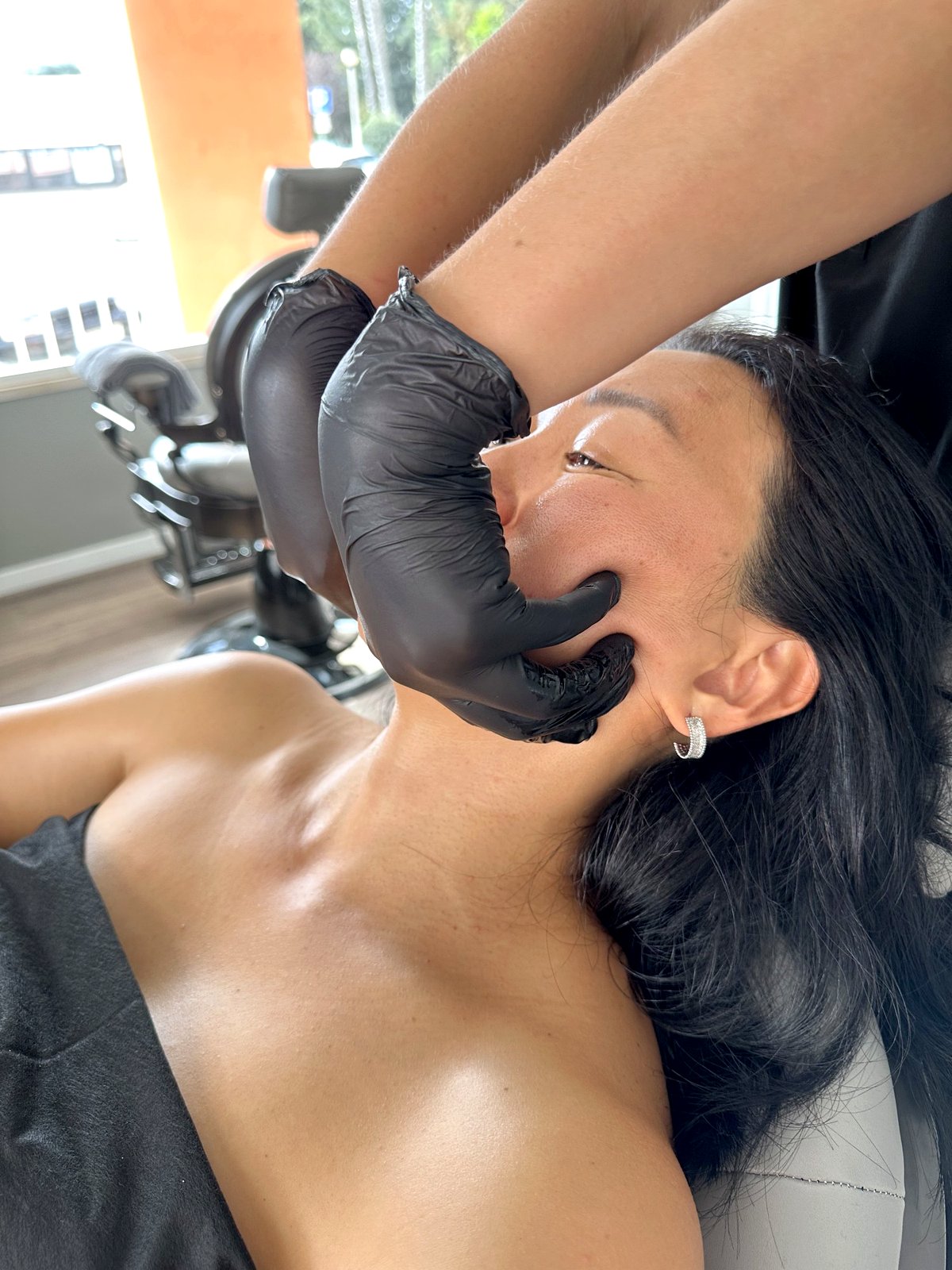
If you drain a face while the neck is tight, the fluid has nowhere to go. That's why, at 360°FACE, we work from the body to the face:
- Neck, shoulders and collarbones first, to release tension and open the main drainage route.
- Then the jaw, from the outside and, in buccal massage, from inside the cheeks.
- Then the face: lymphatic drainage towards the open pathways, and lifting work for the muscles.
Clients often say their face feels "lighter" and their breathing deeper afterwards. That's the fascia letting go.
What you can do at home
- Move your neck every hour: slow circles, look over each shoulder, drop the chin to the chest.
- Unclench: lips together, teeth apart, tongue resting on the palate. Check several times a day.
- Breathe into your belly for a minute, a few times a day. Try this 3-minute routine.
- Gentle self-massage: stroke from behind your ears down to your collarbones before working on your face.
- Drink water and move: fascia stays supple when you walk, stretch and stay hydrated.
FAQ
Is fascia massage painful? It can feel intense in very tight areas, but it should never be more than you can take. Tell your therapist and she'll adjust.
Can it replace fillers or Botox? No. It doesn't add volume or block muscles. It helps your face look rested and less puffy, and many clients find they want injections less often.
How many sessions do I need? You'll feel a difference after one. For lasting change in long-held tension, regular sessions work best; your therapist will suggest a plan.
Lymphatic drainage at 360°FACE
More articles
- Clenched jaw, sore temples? Your face might be holding your stress
- Laptop all day, shoulders up to your ears?
- Your face looks tired, even after a good night's sleep?
- Can face massage really make you look younger?
- Puffy eyes in the morning, dark circles all day?
- Skin after 45: what changes in menopause, and what you can do
- Neck lines and a softer jawline: what you can actually change
- Dull, tired skin: how to bring back your glow
- How often should you get a face massage?
- Stress lives in your face: scalp and face massage for calm and better sleep
- Lymphatic drainage: what it really does (and what it doesn't)
- Lymphatic drainage or facial lifting massage: which one do you need?
- Stress, breathing and a puffy face: a 3-minute reset
Where to find us
Main studio (Parede): Rua Almeida Garrett 112B, Rana, 2785-344 São Domingos de Rana · Directions
Lisbon studio: Rua Azedo Gneco 48B, 1350-036 Lisboa (Campo de Ourique) · Directions
Phone / WhatsApp: +351 915 311 522 · 360face.portugal@gmail.com